

|
Back to |
| The Front Page |
| Letters & Opinion |

|
Reflections on Croquet in Wonderland
by Laurence Latham illustrations by Deborah Latham Layout by Reuben Edwards Posted July 11, 2012
|
If whimsy can be lovingly elaborated at great length in meticulous detail and rest somewhat upon prior knowledge—of “Alice in Wonderland” as well as British croquet culture—these reflections can properly be labelled “whimsy.” They are to be housed permanently in our Humour Department, which in turn is part of the LETTERS & OPINION catchall we’ve reserved for irresistible material we are determined to publish, but for which there is no proper place. Oh, dear! I’m afraid I’m getting into the head-space already of “Croquet in Wonderland,” and I’m not even British!
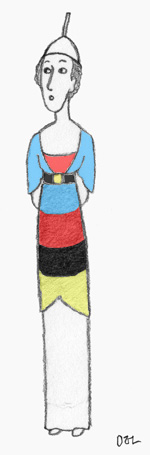
The Thin Lady
“Ow! That hurt!” I complained, instinctively clutching at my head.
“Can’t be helped,” retorted the tall, thin lady who was standing right in front of me. “I have to hit you in order to finish the game.”
|
“I’m sorry, but I don’t believe we’ve met,” I stammered.
“You must be a first-timer, then. I’m Peg. Perhaps I hit you a little hard; I don’t get that much practice with real beginners these days,” she explained, her tone becoming somewhat more conciliatory. “We’ll probably meet more often as you improve. There’s no need to worry, though,” she added hastily, observing my lack of enthusiasm. “As time goes by, you’ll hardly notice the hitting, I promise.”
“But what am I supposed to do now?” I asked, almost without thinking.
“Well, obviously, once a game is finished you have to play through to the beginning.”
I stared at her uncomprehendingly. “Don’t you mean once a game is started you have to play through to the finish?”
“That’s in Advanced Play only, so called because the players advance, of course. Beginners do it the other way round. It’s a concession I worked hard to obtain; you ought to be grateful.”
“It sounds awfully complicated,” I complained.
“Rubbish. How many times does a novice usually play before even reaching me, if the game has to start at the beginning? Lots. And what happens when someone does eventually turn up? We have a horrid emotional scene while they explain how they’ve been missing me. This way, with me hitting you, is both easier and better.”
“Well, now that it’s done, where do I go next?”
“You’re not really supposed to seek advice except from your doubles partner,” Peg reminded me, “but as you’re a complete novice I’ll overlook it. I wonder where she’s got to.”
She glanced about her apprehensively. “Actually, I don’t agree with some of these restrictions myself,” she confided in a low voice. “I have thought of forming a splinter group, but it might be a bit risky for someone like me. Be that as it may, I strongly recommend that in future you read the rules first and play afterwards.”
“Where I come from, we usually play first and read the rules afterwards, quite often in the middle of the court,” I ventured. Peg was unimpressed.
“Go through the red door,” she instructed sotto voce, whilst indicating the direction with a surreptitious nod.
As I watched her walk away, she suddenly turned her head, smiled and called back, “Oh, and mind you beware of the dog.”
The Dog
Before long I was standing in front of a most impressive red door, which looked for all the world as if it were designed to keep people out, especially riffraff. Summoning up courage, I gave a tentative knock. From behind the door there came an ominous growl and I hovered uncertainly.
“No good knocking,” said a voice. “That’ll get you nowhere. If you want to come through you’ll have to open it.”
Nervously I turned the handle and pushed at the door, which swung just far enough to allow a dog to stick its head out.
“What do you want?” it snapped.
“I want to go through,” I began, before really grasping the absurdity of the situation. “But... you’re talking to me!”
“Of course I’m talking to you,” growled the dog. “There’s no-one else here.”
“No, I mean, you’re talking and...”
The creature fixed me with an impatient stare. “I’m talking because I’m quite sane, thank you; if I was mad, I’d probably be barking. Anyhow, that’s enough chat, here comes your partner. Take your lead from her--I don’t have one, as you will doubtless have noticed.”
A young lady was making her way hurriedly across the grass.
“I’m so sorry,” she said, slightly out of breath. “I ought to have been here, but everything seems to have become terribly muddled. I can’t think what’s caused it. Still, I see you’ve reached Rover.”
The dog pricked its ears.
“So, this is Rover,” I acknowledged, hoping to mollify the hound by affording him some recognition. “But he won’t let me through.”
“I know exactly how to sort him out,” countered the young lady, producing a sticklike object from an implausibly deep pocket. She waved to a distant figure before expertly hurling the item in his direction. Rover, who had been watching intently, took off after it like a rocket.
The distant figure quickly picked up the fallen bisque and stuck it in the ground before the dog could reach it. Rover skidded to a halt and stood there wagging his tail.
“That should keep him occupied for a minute,” declared my newfound helper. “Come on, now, through you go. I’ll be right behind you.” She gestured anxiously.
“What if he comes back and stops you?” I postulated unhappily.
“If he does, he’ll find himself with a clip round the ear.” Her confidence spurred me to action and, although still completely mystified, I proceeded without question.
The Foreign Gentleman
Once beyond Rover’s domain, we paused to collect ourselves.
“Look,” I explained apologetically, “I’m terribly confused. I don’t fully understand what’s going on. Who exactly are you?”
“I’m your doubles partner, of course,” replied the girl.
“Yes, but, I mean, what’s your name?”
There was a certain hesitation. “That’s not quite so easy, now you come to mention it. I think it’s... Celia, but I’m afraid I’m rather mixed up myself.”
“If you think it’s Celia and you’re mixed up, perhaps it’s really Alice,” I suggested in a rare moment of inspiration.
“I do believe you’re right! Yes, of course it’s Alice. How stupid of me. Thank you. And may I enquire as to your own name?”
“I’m sorry, I’m...” I began, before instantly experiencing another wave of bewilderment. “Oh dear! Would you believe I can’t remember, either? This is absolutely ridiculous; I could swear I was about to tell you.” I thought hard. “L, I know it begins with L...”
“First or last?” enquired Alice.
“Both, I think.”
“That’s remarkably useful,” she enthused. “Less to learn when you’re very young.”
“Indeed,” I retorted, pleased to be able to pick up on the conversational rhythm. “And handy for initialling notes to friends and business folk alike.”
We had been walking for a few more minutes when I noticed that we were approaching another door. It was similar in appearance to the one where we had met the dog, save for being white.
“See how you get on here,” encouraged Alice. “Remember, though, no knocking.”
I marched up to the door and threw it open, fully intending to stride through, only to find my way blocked by someone standing on the threshold.
|
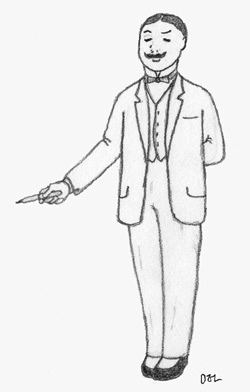
“You are in the big hurry, I dare to say, but first we must attend the paperwork most important, non?”
“Er, well, yes, of course,” I blustered, my encounter with Rover still fresh in my mind. “What do you want me to do?”
“I have here your pass, monsieur, and to go, you have first, please, to sign.”
“Of course,” I smiled, fumbling unsuccessfully for something with which to write.
Seeing my predicament, the foreign gentleman made sympathetic tutting noises before proffering a very fine looking fountain pen with a gold nib.
“Here, monsieur, allow me to hire you mine.”
“Um, thank you,” I said, trying my best to sound polite. “But I think you mean lend, don’t you?”
“Oh, non, monsieur, I mean hire. It will be only ten euros and it can be added to your bar tab, if you wish.”
“No,” I answered firmly, “I don’t wish. Ten euros is extortionate!”
“I think not, mon ami,” smiled the guardian of the white door. “After all, I am offering you--how would you say in English?--the pen ultimate.”
Before I could argue any further, Alice poked her head around the door. “Quickly,” she urged. “Give him what he wants or else we’ll never get back to the start.”
I signed the paper with the forcibly hired pen and we hurried off.
The Spy
It was not too long before we found ourselves at another white door, which was standing slightly ajar. It looked rather dark inside, and everything lay very still and quiet.
“Perhaps there’s no-one here this time,” I suggested hopefully.
“Maybe not, but we can’t be too careful,” murmured Alice. “All right, here we go.”
|
“Who are you?” I blurted out, before I could stop myself.
“None of your business.” The voice was deep and stern.
Alice appeared at my shoulder. “It’s all right,” she whispered. “He’s nothing to do with us. Just pretend you haven’t seen him.”
Nonetheless, it was too late. The man moved out from his shady alcove to stand in our way.
“But you have seen me, haven’t you?” he breathed threateningly.
“Well, not very well,” I objected, trying to play down the situation.
“Was that well or not well?” growled the man. He threw out a hand. “Handicap Cards,” he demanded.
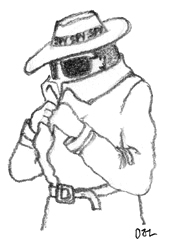
Alice and I produced our cards with subservient swiftness and the man snatched them brusquely. He was out of the deep shadow now, and I could see the word Spy repeated again and again, running around the brim of his hat. He caught the direction of my gaze.
“Disregard that,” he warned, menacingly. He studied our cards carefully for several seconds, grunting at Alice’s and sneering at mine. Finally, he tossed them back. “Bona Fide C Class, double banked. Lucky for you. There’s an A game coming through here any time soon; make sure you stay out of the way. Right?”
I was terrified Alice was about to argue and for once tried to take the lead in getting us moving.
“One more thing,” interrupted Spyhat ominously, and my heart sank. “Couldn’t give us a light, could you?”
My pulse was racing again. “I--I’m afraid I haven’t any matches,” I apologized, and swallowed hard.
“What? Do you take me for a fool?” The man moved closer and caught hold of my collar with both hands, while studying me intently from behind his dark glasses. “You’re in a tournament, aren’t you?”
“Y-y-yes,” I quavered.
“Then you must have matches, mustn’t you?” His voice was slow and deliberate. “You can’t play in a tournament without matches, now can you?”
“No intimidation of beginners!” yelled Alice suddenly. To my amazement, Spyhat let go of my collar, made a superficial attempt at smoothing my rumpled shirt, and stood back.
“Young lady’s right, of course,” he smiled. “Sorry about that, sir. Got a bit carried away; it’s the job, you know, arranging contacts. I’m used to dealing with a completely different bloc. Some of them can be difficult. Tell you what, you can pick up some matches next door but one. It’s quite some distance but you can’t miss it; place with the blue door. Pleasure to meet you both, I’m sure.”
With that he was gone and we were left outside, shaken but not stirred. I turned to Alice.
“What’s this place where we can get matches?” I enquired.
She looked at me quizzically, “That’ll be the twobackonist’s, of course. Shall we go?”
A Hat and a Rabbit
Without further ado, we reached the blue door, only to find it locked, barred and bolted, and with a Closed sign hanging on the inside of its window.
“Oh, dear,” exclaimed Alice. “That’s that for the time being, then; we’ll have to come back later. Never mind, at least we can go and sit down for a while.”
We made our way to a row of chairs, empty save for one occupied by an odd-looking character in a top hat. He gave Alice a cursory nod, but as I made to sit down, he really stirred into life.
“That’s someone’s chair,” he protested loudly.
“But there’s nobody sitting here,” I objected, taking a good look round to make certain there were no other potential claimants in the vicinity.
“I didn’t say there was,” he retorted. “I was merely pointing out that it belongs to someone. Please, do sit down.”
“Thank you.” As I was making myself comfortable, I couldn’t help noticing that his hat bore a large label which I could only assume was a price tag. Having by this time observed that Alice had a tendency to deal with all the strange folk we were meeting in quite a forward way, yet without causing offence, I determined to follow suit.
“Why does it say ten and six on your hat?” I enquired boldly.
“It doesn’t any more. Read it again, slowly and carefully.”
“Ten - s - six - d,” I enunciated the constituent parts. “That’s ten shillings and sixpence, surely. Do you sell them?”
“I am a hatter and I do sell them,” he confirmed, looking a little exasperated. “But that is definitely not a price tag--a hat of this quality and style costs a good deal more than that these days, I can promise you. If you really must know, it’s there to remind me of my handicap: Ten for Singles, Six for Doubles. I’m better at doing what I’m told than telling what I do, you understand.”
I assured him that I did. Before we could continue our conversation, however, we were interrupted by the sound of panting as an apprehensive figure rushed past.
“Oh, dear, oh, dear!” it cried. “I’m awfully late. I’ve never got used to these horrible nine thirty starts. I must find the Manager at once, but I’m going to be in terrible trouble.”
“Who was that?” I asked Alice.
“That was the White Rabbit,” she explained. “It’s quite complicated really; he’s played for by beginners somewhere else in the winter and only plays himself here.”
“Only plays himself?” I queried. “What’s the point of that?”
“That’s not what I meant. This is the only event in which he competes. Don’t be so pedantic.” She brooded for several seconds before continuing. “Actually, this must be the only place he can play, for I’m sure it’s totally unlike any other.”
“It certainly is very odd,” I agreed, suddenly aware that I had begun to take it all for granted. “But you seem to know your way around. Have you played here before?”
“Perhaps I did once, a long time ago,” she pondered. “Yes, I suppose I must have done, because some things are rather familiar, and yet,” she faltered, “I’m sure it wasn’t quite like this.”
I turned once more to the Hatter.
“Are you here to play or watch?” I enquired, trying to sound convivial.
“I’m here to call Time,” came the reply. “I was asked because I know Time quite well.”
“But this isn’t a timed game,” I pointed out.
“Then don’t stop when I call,” snapped the Hatter. “Anyway, you might want Time for something else. What if you needed to tie your shoelace, for example? What would you do then, if there was no Time? You don’t always bother to think things through, do you? You really ought to be more appreciative towards people who are trying to help.”
I felt it better not to prolong the interchange and so sat quietly until a few moments later, when Alice tugged on my sleeve.
“Up you get,” she encouraged. “We have to play again. The twobackonist is open now.”
Matches and Pipes
|
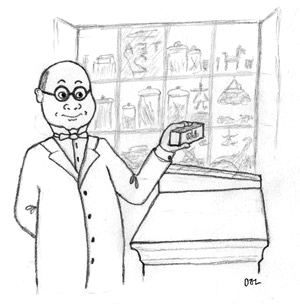
“Good morning, madam. Good morning, sir.” We were greeted by an amiable-looking man in thick rimmed glasses. “What may I do for you?”
Alice indicated that I should do the talking, so, without further ado, I requested a box of matches.
“Danger, Safety or Safety Gone Mad?” enquired the twobackonist.
“Er... Safety would be best, I should think.”
“Good choice. Very wise,” smiled the shopkeeper. “The others wouldn’t be much good to you. Danger are inclined to ignite by themselves in your pocket, and Safety Gone Mad have no heads, so they won’t light at all.” He pushed a box of Safety across the counter. “That will be six and fourpence three farthings; should I add it to your bar tab?”
“Yes, please,” I confirmed, realizing that I carried no change, “but I don’t think we can put farthings on.”
“No problem, sir; let’s call it thirty two pence, shall we?”
It was at that moment that I noticed a large sign above the counter which read “No Smoking”.
“Isn’t that a little detrimental to business?” I asked, nodding in the direction of the warning.
“Goodness me, no, sir. We don’t cater for smokers here. Don’t want to encourage anything like that these days, do we? Most unhealthy. We limit ourselves to matches and pipes.”
“Pipes?”
“Oh, yes, sir. Water pipes, gas pipes, drainpipes and stovepipes--in our outfitting department--exhaust pipes, downpipes and half-pipes, which are very popular among our snowboarding clientele.” He was edging forward and waving his arms with growing excitement and I stepped back, instinctively. My foot sank into something soft and there came a horrible wailing screech.
“Not forgetting bagpipes,” he finished triumphantly.
“Let’s get out of here,” I exclaimed, urging Alice in the direction of the door.
“By the way,” the twobackonist called after us, “if you see the Chimneypotamus, tell him his fluepipes have arrived.”
“The whatawhatamus?” I asked incredulously, as we strode away from the shop, failing to believe my ears.
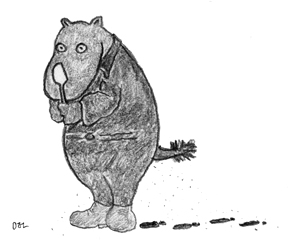
“The Chimneypotamus,” corrected Alice. “I’ve not come across him yet, myself, but I’ve heard he’s started to take an interest in croquet and may be organizing a barbeque later. The only trouble is his unfortunate tendency to go round getting everything dirty, so most people try their best to keep him away. It’s absolutely necessary but an awful shame, because he’s said to be quite friendly, in his own way.”
“He sounds rather interesting,” I mused. “Could you tell me a bit more about him, please?”
“That’s easy. There’s a poem which explains it all; if I remember rightly, it goes like this..” And as we walked, Alice began her recitation:
Beware the Chimneypotamus,“It’s a pity about the dirt and mess,” I acknowledged, realizing the rhyme was at an end, “but thank you for telling me. I must say I’m rather hoping we might meet him after all.”
He has such sooty paws,
But loves to climb on furniture,
Like beds and chests of drawers.He leaves a trail of small black prints
In patterns quite bizarre,
On table, chair and writing desk,
Yes, even escritoire.He makes investigation close
Of alcoves, niches, nooks;
And tends to stroll on bookcase shelves
He finds devoid of books.Exploring in the kitchen, bold,
He’s nimbler than you’d think;
Prints lead across the draining board,
A few are in the sink.His mouth displays a friendly smile
Beneath a massive nose;
The little ears atop his head
Offset his chunky toes.He walks about on hefty feet,
With body rather plump;
His two hind legs each half support
A more than ample rump.And at the back he swings a tail
With bristles like a brush,
Which could be used to clean a flue,
Or two, were there a rush.Beware the Chimneypotamus,
Be sure he stays outdoors,
For if he gets inside your house
He’ll blacken all the floors.
The Twins
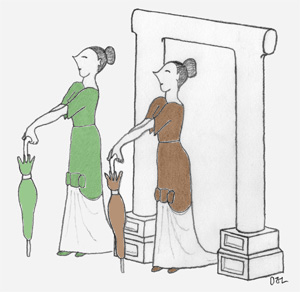
By this time Alice and I were nearing our next port of call. We could see two ladies who would have been indistinguishable from each other had one not been dressed in green and the other in brown.
“Good morning. Good morning,” said Alice politely, and I followed her lead, addressing each of the pair separately.
|
“And I’m Mrs Green,” said the other, who had stationed herself close by. “We are twins, as you will no doubt have noticed.”
“Indeed we had,” agreed Alice. “You certainly look very much alike.”
“Indistinguishable,” insisted Mrs Green.
“Identical,” confirmed Mrs Brown.
“Be that as it may,” said Alice, “could we please ask you to move, so we can go through?”
“No,” said Mrs Green. “Your shoes aren’t particularly clean.”
“Certainly not,” said Mrs Brown. “Your hair isn’t very tidy and your partner has mud on his trousers.”
“How very rude!” exclaimed Alice. “It’s not your place to point out such things, even if they are true. And, what’s more, you’re in our way.”
“I’m not rude, I’m just critical,” objected Mrs Green.
“And I’m very critical,” added Mrs Brown. “We’re not moving. Go away and come back later.”
Alice came over and whispered to me, “I’m afraid that’s what we shall have to do. They must be part of that A Class game the Spy warned us about and they’ve definitely got it right about being critical. Let’s go and wait.”
We moved away towards the boundary without offering any valediction.
“They had no need to be so discourteous,” muttered Alice.
Back at the chairs we found the Hatter talking to a fellow with very tall ears and carrying a notebook.
“That’s the March Hare,” whispered Alice. “He’s a pretty good player, definitely no rabbit.”
Without introduction, the March Hare fixed me with a meaningful gaze and flicked open his notebook.
“While the White Rabbit is away being someone else’s trophy, I’ve decided we should hold our own winter tournament here,” he announced confidently. “I shall be managing, of course. Would you like to enter? The fee will be two guineas; I’ll add it to your bar tab.”
“When does it begin?” I asked cautiously.
“December the twelfth at eight o’clock sharp.”
“That’s awfully early,” I exclaimed.
“I could put you down for one of the late starts,” offered the March Hare.
“And when would that be?”
“Half past two, on February the fifth. That any use to you? It’ll be a very good tournament,” he went on, seeing my continuing hesitation. “Level play, but with everybody having eight thousand, one hundred and ninety two bisques.”
“Won’t that make it all rather pointless?” I ventured.
“Oh, no, no, no!” he said quickly, sensing my erroneous thinking. “The bisques won’t be for making breaks, they’ll be for making bonfires. The players will need to keep warm; it can get very chilly here at that time of year, you know.”
“Look, I may not be able to,” I explained, ruefully.
“Well, that’s your money gone, then. I can’t offer a refund at this late stage, can I?”
Fortunately, before this could go any further, Alice interrupted to say that the twins had left, thereby enabling us to continue on our way.
No sooner had we entered the doorway when a voice called out, “Mind the gates, please!”
It belonged to an officious sounding lift attendant wearing a dark uniform. He looked us up and down with an air of resigned disappointment.
“C Class!” he exclaimed. “You certainly won’t be wanting my services, then. This morning’s turning out to be a right waste of time. This other lot didn’t want me either. Fancy themselves, these sextuplers, if you ask me. Old fashioned lift not good enough any more. Oh, no, prefer to draw a crowd and then take the stares. Stand back, there, if you don’t mind.”
With that, he pulled the gates together with a crash and his grumbling voice faded away into the distance. The lift had gone.
The Prisoner
To my surprise, the next white door we came to swung open automatically with an electrical buzz as we approached it.
“That’s different,” I commented, and Alice agreed, admitting that, although she undoubtedly had more experience of the place than I did, many things were strange and new to her as well.
“I didn’t play much croquet here before and, besides, I’m sure it wasn’t to such serious rules,” she confessed. “Oh, my goodness! Who are you?”
A man was regarding us with a good degree of suspicion. He was dressed in smart trousers, turtleneck pullover and a dark blazer with contrasting edging around its borders. For once, I was ahead of the game.
“You are Number Six!” I exclaimed.
“I am not a number, I am a free man,” he growled. “What do you want?”
“We want,” I began, aware that Number Six was regarding us with a steely expression, “to get to the beginning of the game.”
“You started at the end?”
“ Yes. This is a very queer place.”
“Agreed, but I don’t believe you; that would mean you got past Rover. You’re just another of Number Two’s little tricks. You’re plants!”
“No, we are not,” cried Alice. “I’ve been through this ‘Animal, Vegetable, Mineral’ thing before.”
This particular interjection seemed to transform his whole attitude in a trice.
“Very well,” he said cordially. “Whatever you do, keep going until you’re beyond the reach of Number Two. After that it’s up to you.” He showed us to the door and gave a curt wave. “Be seeing you!”
From then on, progress was remarkably swift, with the majority of folk quickly getting out of our way as they saw us approaching. It was a most amazing change, for we were soon through doors that earlier we would have considered serious obstacles.
“What’s happening?” I asked Alice, feeling both pleased and puzzled.
“The game gets easier this way round,” she explained, “even beginners usually make some progress near the start.”
Once safely past the imposing entrance to Number Two’s residence, we paused and looked about us.
To Tickets and Trains
“One more door,” gasped Alice, trying to recover her breath. “The blue one, over there.”
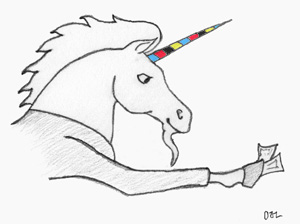
We passed through the final doorway to enter a room of most singular appearance. On the far side stood a large reception desk, with what I initially took to be a white horse sitting behind it. When the creature looked up, however, I saw that it had a solitary horn protruding from its forehead.
“I’m so pleased you could make it,” said the Unicorn. “We don’t get too many here from your direction. I’ll just get you your complimentary tickets.”
“Tickets?” I enquired at this unforeseen turn of events.
“Why, yes, your train tickets, of course. You’ll need them to get home. I’m afraid the station is some way east of here, and once there you must make absolutely sure you catch a Baulk Line train.”
“So croquet is a bit like chess!” exclaimed Alice. “I had to catch a train in that, too.” She paused, pleasantly surprised at her unexpected memory. “Only then there wasn’t a ticket office and I nearly got into trouble. I think this is much better.”
|
“I am pretty tired,” I confessed. “It’s been a long game. As soon as we’ve finished I think I’m going to lie on the grass.”
“Lion the Grass?” spluttered the Unicorn in sudden outrage. “We’ve had our differences and many a good fight, but I certainly didn’t have him down as a snitch! I would never have shared that plum-cake with him if I’d thought...”
“I said I was going to - lie - on - the - grass,” I repeated slowly.
“Well, I wish you’d make yourself clear from the start,” said the Unicorn sulkily. “I might have made a false accusation and handed him the moral high ground. He has enough advantage over me as it is, in the mane.”
I had to admit he had a very good point.
Our walk to the station was without incident and it wasn’t long before we were able to board our train. We waited patiently for some time but still we failed to get under way. Eventually, when the guard happened to walk past, I managed to waylay him and enquire as to what was going on.
“Sorry for the delay, sir, madam,” he apologized. “Should be off soon, but it seems there’s been some difficulty with the points.”
“What sort of difficulty?” I pressed, irritated at this unexpected setback.
“Oh, apparently they don’t add up or something, sir. It’s all beyond me; I work for the train operator, you see. We don’t keep track of points any more; that all comes under a different organization now. But, if it’s any help, I did hear it’s to do with a missing clip or some such nonsense. ‘For the want of a nail’ and all that... I’m sure we shall be on our way soon.”
Indeed, after several more minutes we did finally get going but, before hardly having time to rejoice in our progress, we felt the train slowing down again and sure enough we soon came to another complete halt amid a prolonged squeal of brakes.
“Now what?” complained Alice.
In due course, I saw the guard coming back. “What is it this time?” I called. “Leaves on the line?”
“Got it in one, sir!” announced the guard. “I thought you might ask, so I made enquiries. Apparently it’s to do with an important game; First Class, I think.”
“A Class,” corrected Alice.
“All right, A Class, then, or whatever you want to call it. Well, they have these here special leaves, all complicated type of thing and not to be disturbed; so the likes of us have no choice but to wait.” He sauntered off down the corridor, grumbling to himself about privileged classes.
“I’m sure there wasn’t nearly as much trouble the last time I was on a train here,” observed Alice, “even when I didn’t have a ticket. I’m beginning to think this isn’t so much better after all.”
At the end of our somewhat fraught journey we made our way out of the rather smoky station, handing our used tickets to the collector at the gate.
“We’re very sorry for the delays and inconvenience,” he declared politely, “but, as your tickets were free, I’m pleased to tell you that under the circumstances you are entitled to a full refund of the cost. Would you like claim forms?”
“No, thank you,” replied Alice wearily. “I’m sure nothing would be too much trouble for your company.”
The Barbeque and the Cat
Outside, we were surprised to find the atmosphere was even smokier than in the station.
“Oh, look,” exclaimed Alice in delight, “that must be the Chimneypotamus; it’s coming from his barbeque.”
“Sausage?” he offered, as we approached, enthusiastically waving something black on the end of a long fork. It wiggled back and forth, leaving a rather endearing little trail of smoke zigzagging in its wake.
“Um, no, thank you,” declined Alice, albeit a little afraid she might disappoint him. “But we did very much want to meet you.”
We continued chatting for a while to the Chimneypotamus, who expressed great interest in the game of croquet, but when people who were genuinely in search of food began to gather round, we felt it appropriate to move out of the way.
“It’s been a real pleasure meeting you,” he beamed. “The charcoal biscuits are over there; please, do help yourselves.”
“He sounded quite keen,” enthused Alice, once we were away from the barbeque (and the charcoal biscuits). “I really think he might begin to play!”
“I can’t see him in whites, somehow,” I observed, a little dryly.
“Don’t be so judgmental,” admonished Alice. “People can change, you know.”
I felt suitably chastened, even though I had intended my remark to be taken largely in jest.
|
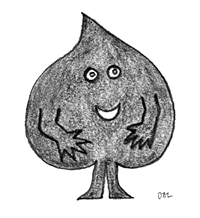
Back by the barbeque, the Ace and the Chimneypotamus were laughing and joking like old friends. At one point, the Chimneypotamus became so carried away that he allowed the kipper tie which he was wearing (perhaps a little unwisely) to dangle on to the fire. A glowing orange line began to ascend it, rather in the manner of blue touch paper, and the Ace went flying into action. Grabbing a jug of water which had sensibly been kept at hand, he threw it over the smouldering tie, only for a goodly quantity to land on the barbeque, causing a loud hiss and a great cloud of steam.
“That’s added mist to the grill,” whooped the Chimneypotamus, hastily removing what was left of his neckwear.
We decided to leave them to it and were beginning to wander towards the Clubhouse when I became aware that we were being observed by a rather large cat apparently sitting upon nothing, about fifteen feet up in the air.
“ What on earth is that?” I enquired, somewhat startled.
“That’s the Cheddar Cat,” explained Alice. “He’s taken to sitting up there since he was banned from entering tournaments. But you needn’t worry about him, he’ll probably vanish again in a minute or two.”
There were several questions I wanted to ask at once.
“How did he get up there?”
“He climbed the cedar tree, of course. How do you think?”
“But there’s nothing there,” I protested.
“Well, there was when he climbed up, but now it’s disappeared. That’s why it’s called the cedar tree; because you can’t.”
“Can’t what?”
“Cedar tree any more, obviously. Must I go on explaining everything?” frowned Alice.
“Yes, I’m afraid you’re going to have to. This place still has me totally confused; it’s completely bizarre. Yet there was something you just said which... oh, I don’t know. Please, do carry on.”
“Very well,” conceded Alice, drawing a deep breath. “Look, it’s like this: as I’m given to understand, the Cheddar Cat originally came here with an Oxford professor and has been around on and off ever since. He learnt to play and quickly got down to scratch--almost all cats do, as I’m sure you know--but that was the trouble. Every time he entered an event he would end up scratching. He became a manager’s nightmare and had to be banned, so now he just watches, usually from up there.”
Once again I looked up at the cat, which seemed to be blurring round the edges. “What’s happening now?”
“He’s leaving. Like most cats, he wanders off from time to time. He’ll gradually fade away until there’s only a strand of DNA left, hence both his attachment to the Oxford professor and his being called the Cheddar Cat.”
“How exceedingly weird!” I exclaimed.
“Not at all,” protested Alice. “Lots of things vanish but leave traces of DNA. I should have thought you would know that. In fact, now that I come to think of it, our cat Dinah was mostly DNA.”
“I felt I almost did know something for a second or two back there,” I declared thoughtfully, “but it seems to have gone again. Just like the Cheddar Cat.”
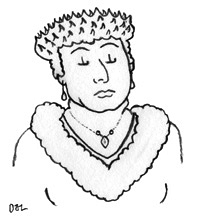
All at once there was something of a commotion as the White Rabbit appeared carrying a bell and calling for everyone to make way. He was leading an entourage at the centre of which walked a most striking looking lady possessed of whitish hair crowned with golden highlights.
“Who’s that?” I asked Alice in a hushed tone, fearing others might become aware of my ignorance.
“That,” she replied in an equally low voice, “is the Queen of Puddings.”
The procession halted.
|
“We’re having a barbeque, may it please your Majesty,” explained the Chimneypotamus uncertainly.
“We are not at all sure that it does please us,” observed the Queen. “These people will be left with very little appetite for sweetmeats!”
There was a general mumble of respectful denial.
“Very well,” allowed the Queen, “be sure to eat cake at teatime.”
To this, there arose a somewhat louder murmur of affirmation.
|
“And what, may we ask, young man, do you intend to do about reducing your carbon footprint?”
“I shall clean my shoes more frequently, your Majesty.”
“Highly commendable. Most astute. We are minded to offer you the contract to oversee the efficient running of all our flues and chimneys. If you agree, the White Rabbit will deal with the paperwork immediately.”
“Thank you, your Majesty, I am most grateful,” exclaimed a delighted Chimneypotamus, bowing (though not so low as to risk being overbalanced by his relatively sizable nose).
The White Rabbit hurried forward to oversee the written formalities, which he then tried to conduct, rather awkwardly, at arm’s length.
That finished, the Queen of Puddings declared it was time for tea and the White Rabbit began loudly ringing his bell.
Tea
And it really was the tea bell, after all.
Epilogue
My head still slightly fuzzy, I remained sitting where I was for a minute, watching the tournament players, clad in white, competing on the tidy, regulation courts with neat boundaries and narrow hoops. I contemplated the empty space where a cedar tree had stood for so many years, and marvelled at how elements of reality can infiltrate the most outlandish dream.
I carefully picked up my fallen reading material, which consisted of a combined edition of Alice’s Adventures in Wonderland and Through the Looking-Glass and a recent copy of the Croquet Gazette.
Despite the total absurdity of it all, I knew there was something else I had to do before thinking about tea. Like a young child forced to look under the bed after waking from a nightmare, I headed for the empty bar and, once there, furtively checked my tab.
Laurence Latham lives in the South West of England. He joined the English Croquet Association in 1972 and was at various times a club member at Bristol, Cheltenham, Bath and Taunton Deane. He ceased to belong to any club in the late 1980s, and his appearances on court are now usually limited to one three-day tournament per season. Notable achievements include owning the same car for almost 22 years, and still not having acquired a mobile phone. Although in 2003 he also authored a book of (non-croquet) short stories under the title In The Absence Of Bats, his first offering of fiction to the English Croquet Gazette was Reflections on Croquet in Wonderland. The illustrations for this story were provided by Deborah (his wife since 1980), who also collaborates with him on the Croquet Gazette’s Hoopopotamus cartoon strip and is the author of How To Shoot Croquet Players on this website.